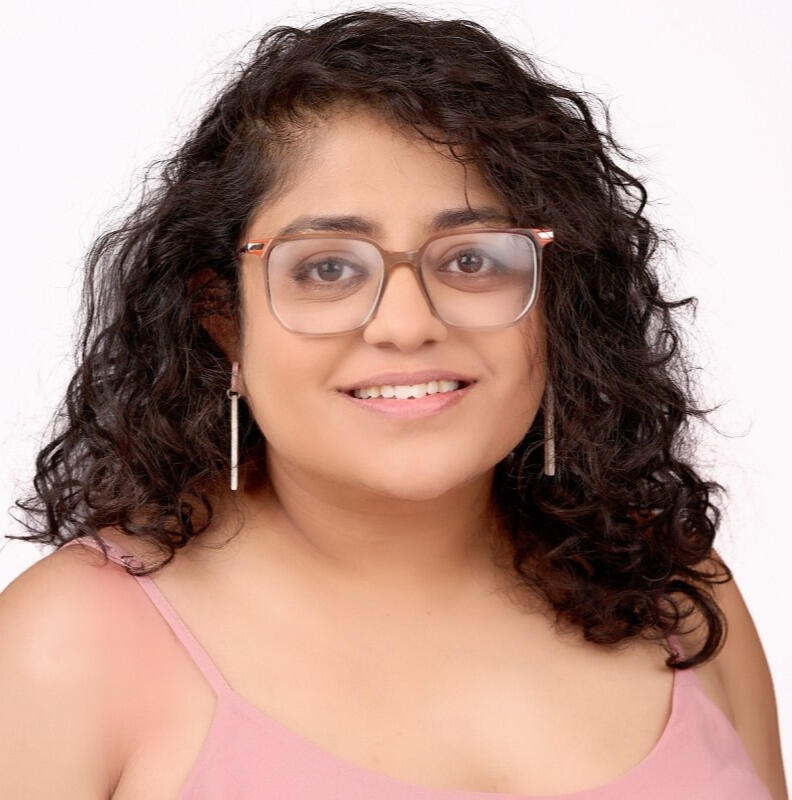
Vardha Kharbanda, MA
(she/her/hers)
Clinical Psychology Ph.D. Candidate, Illinois Institute of Technology
About me
Hi, I'm Vardha — a Ph.D. candidate in Clinical Psychology at Illinois Institute of Technology, originally from New Delhi, India, where my curiosity about people and my tolerance for very spicy food both developed (one of these is going better than the other).My work is driven by a simple but stubborn belief: mental health care should actually work for the people who need it most. Growing up as a first-generation student navigating academia across two continents gave me more than just a collection of frequent flyer miles. It gave me a firsthand understanding of the barriers that minority and marginalized communities face, and a genuine urgency to do something about it.I take an interdisciplinary, multicultural approach to psychology, meaning I think the field has a lot to gain from listening to voices it has historically ignored. My goal is to help build a version of mental health care and education that is culturally grounded, accessible, and built with communities rather than just for them, with a particular focus on India and the South Asian diaspora.When I'm not deep in research or clinic, you'll find me hiking, cooking, traveling, or confidently ordering "extra extra extra spicy" at restaurants and being statistically, reliably let down every single time. I'm multilingual, endlessly curious, and genuinely believe that good psychology starts with good listening.
Education
Ph.D., Illinois Institute of Technology, Clinical Psychology August 2022-Present
M.A., Adelphi University, Psychology (SPECL: SUDs)
August 2019-August 2021
B.A., University of Delhi, Psychology
May 2016-May 2019
Research
At the core of my work is a pretty straightforward question: why do some people thrive under pressure while others are pushed toward the edge? I use Self-Determination Theory as my primary lens to understand how autonomy, relatedness, and competence shape motivation, well-being, and health behaviors, particularly for people who have historically been on the margins of both society and psychological research.A significant thread of my work focuses on substance use and public health communication. My dissertation examines vaping and e-cigarette use through the lens of motivational science, asking not just who vapes, but what actually moves people to quit, and whether the messages we craft to help them do that are landing the way we intend. Spoiler: they often aren't, and that's worth studying.I'm also deeply interested in how stressors like discrimination, stigma, and structural inequity get under the skin. I study how these experiences shape help-seeking behaviors and behavioral health outcomes within minority communities, and what it means when the very systems designed to help people are built in ways that quietly exclude them.
Current Projects
Ph.D. Dissertation: Vaping, Motivation, and Public Health Messaging
Applying motivational science and Self-Determination Theory to understand vaping behavior and evaluate the effectiveness of cessation messaging. The goal is to develop communication strategies that actually resonate, especially for the undercared populations.
Cumulative Adversity and Child Mental Health
Examining dose-response relationships between multiple forms of childhood adversity and mental health comorbidities across psychological domains. How much does adversity stack, and what does that mean clinically?
Autonomy Support and LGBTQ+ Well-Being
Investigating how coming-out decisions with healthcare providers are shaped by autonomy, trust, and support, and what it means for LGBTQ+ patients when those dynamics go wrong.
The Regressive Model of Self-Stigma
Developing a new theoretical model of how self-stigma progresses and compounds over time for people with mental illness.
Western Psychology's Borrowed Frameworks
A focused critical analysis of cultural appropriation and erasure in Western psychology, with particular attention to Maslow's hierarchy of needs and indigenous knowledge systems. Basically, a love letter to accountability.
Cross-Cultural Teen Perspectives on Parental Digital Support
A qualitative multi-country study on how teenagers perceive parental support around digital behaviors.
Past Projects
Non-Suicidal Self-Injury and Substance Use in American Youth (Master's Thesis, Adelphi University, 2021)
My master's thesis examined the relationship between non-suicidal self-injury, substance use, and family characteristics in American youth. These two behaviors show up together far more often than they're studied together, and I wanted to understand why. This work planted the seed for my broader interest in disinhibiting behaviors and the relational factors that put young people at risk.
The Psychosocial Effects of the Blockade on the Wellbeing of Family and Children in Qatar: Stress, Coping and Resiliency
This project explored the psychosocial effects of the 2017 Gulf blockade on families of Qatari nationals and residents. The goal was to identify and assess the support systems and coping strategies that best predicted levels of psychological well-being, distress, and resilience among affected family members.
The Psychosocial Effects of the Blockade on the Wellbeing of Family and Children in Qatar: Stress, Coping and Resiliency
This project explored what happens to families when geopolitics shows up at the dinner table. We examined the psychosocial effects of the 2017 Gulf blockade on families of Qatari nationals and residents, with a focus on identifying the support systems and coping strategies that best predicted psychological well-being, distress, and resilience among those affected. Because when entire families are separated by political decisions overnight, the psychological fallout doesn't wait for policy to catch up.
AIM 4 Teen Moms
This program was built on a simple but radical idea: that motherhood is an identity strength, not a scarlet letter. We worked with teen mothers to foster a sense of control over their futures and reproductive choices, reframing narratives of stigma into ones of agency and resilience. The long-term goal was to reduce rates of unprotected sex and repeat pregnancies by giving young mothers something the research consistently shows matters most: the belief that their choices are their own.
Publications
Posters and Presentations
Kharbanda, V. (2026). Autonomy Over Authority: Motivational Science for Vaping Cessation. [Psych-Science-in-3 Competition]. American Psychological Association Annual Convention, Washington, D.C., United States.
Kharbanda, V. (2026). When adversity compounds: The simultaneous impact of cumulative childhood adversity on child mental health [Poster session]. American Psychological Association Annual Convention, Washington, D.C., United States.
Kharbanda, V. (2025). Unmasking inequities: Reforming clinical psychology training for a culturally competent future [Critical conversation]. American Psychological Association Annual Convention, Denver, CO, United States.
Published in Peer-Reviewed Journals
Chua, S. N., Chong, J. E., Chee Lee, K. Y., Kharbanda, V., Ren, Y., Pinheiro-Mehta, N., Darshini, S., & Sheehan, L. (2025). Exploring the stigma of suicide in Malaysia: Lived experience perspectives. Death Studies, 1–12. https://doi.org/10.1080/07481187.2025.2468169
Kharbanda V. (2022). Understanding issues in the Indian education system through the lens of the movie 3 Idiots (2009). International Journal of Indian Psychology, 10(1), 877-887. dip:18.01.090.20221001, doi:10.25215/1001.090
Abu-Ras, W., Elzamzamy, K., Burghul, M. M., Al-Merri, N. H., Alajrad, M., & Kharbanda, V.you (2022). Gendered Citizenship, Inequality, and Well-Being: The Experience of Cross-National Families in Qatar during the Gulf Cooperation Council Crisis (2017–2021). International Journal of Environmental Research and Public Health, 19(11), 6638. https://doi.org/10.3390/ijerph19116638
Kharbanda, V. (2021). Case study inquiry on psychosocial outcomes of uninvolved parenting in the Indian context. International Journal of Sociology of the Family, 47(1-2 (2021)), 15–38. https://serialsjournals.com/abstract/862382-casestudyinquiryonpsychosocialoutcomesofuninvolvedparentingintheindian_context.pdf
In Prepration
Kharbanda, V., Ali, B. (in preparation). Cumulative Adversity and Child Mental Health Comorbidity: Examining Dose-Response Relationships Across Multiple Psychological Domains.
Corrigan, P., Shah, B., Kharbanda, V. (in preparation). The Regressive Model of Self-Stigma.
Kharbanda, V., Legate N., Springer C. (in preparation). Understanding the relationship between non-suicidal self-injury and substance use among American college students.
Teaching
I teach because I genuinely believe that a good classroom can change how someone sees the world, and more importantly, how they see themselves in it. My approach to teaching is rooted in the same values that drive my research: equity, cultural humility, and the conviction that psychology is most powerful when it reflects the full range of human experience, not just the slice that has historically dominated the textbooks.I try to build classrooms where curiosity is the baseline and no question is too basic or too strange. Having navigated academia as a first-generation international student, I know firsthand how disorienting it can feel to sit in a room full of knowledge that doesn't quite seem built for you. That experience shapes how I teach every single day. I draw from diverse pedagogical approaches, integrate real-world examples, and actively work to make course material feel relevant to students from all backgrounds, because the best psychology education doesn't just teach concepts. It teaches students to think critically about whose experiences those concepts were built on.My goal isn't just to get students through a syllabus. It is to be the kind of educator who makes students feel like their perspective belongs in the discipline, and maybe even plants the seed for a career in it.I have had the opportunity to teach the following courses to undergraduate students at Illinois Tech:
Adjunct Professor, Introduction to Psychological Science (PSYCH 221)
Summer 2026, Spring 2026, Summer 2023,Adjunct Professor, Introduction to Psychopathology (PSYCH 303)
Spring 2026, Spring 2025, Fall 2024, Fall 2023Adjunct Professor, Neural & Biol Bases of Behavior (PSYCH 414)
Fall 2025Guest Lecturer, Addictions and Psychopharmacology: Special topic: Smoking Cessation (PSYC 588)
Fall 2025Guest Lecturer, Psychological Testing: Special topic: Neuropsychological Testing (PSYC 409)
Fall 2025Guest Lecturer, Psychology of Gender: Special topic: Body Image Issues and Social Media (PSYC 340)
Spring 2024Guest Lecturer, Psychological Testing: Special topic: Projective Personality Tests (PSYC 409)
Fall 2023
Contact me
Click on the links below to connect with me!